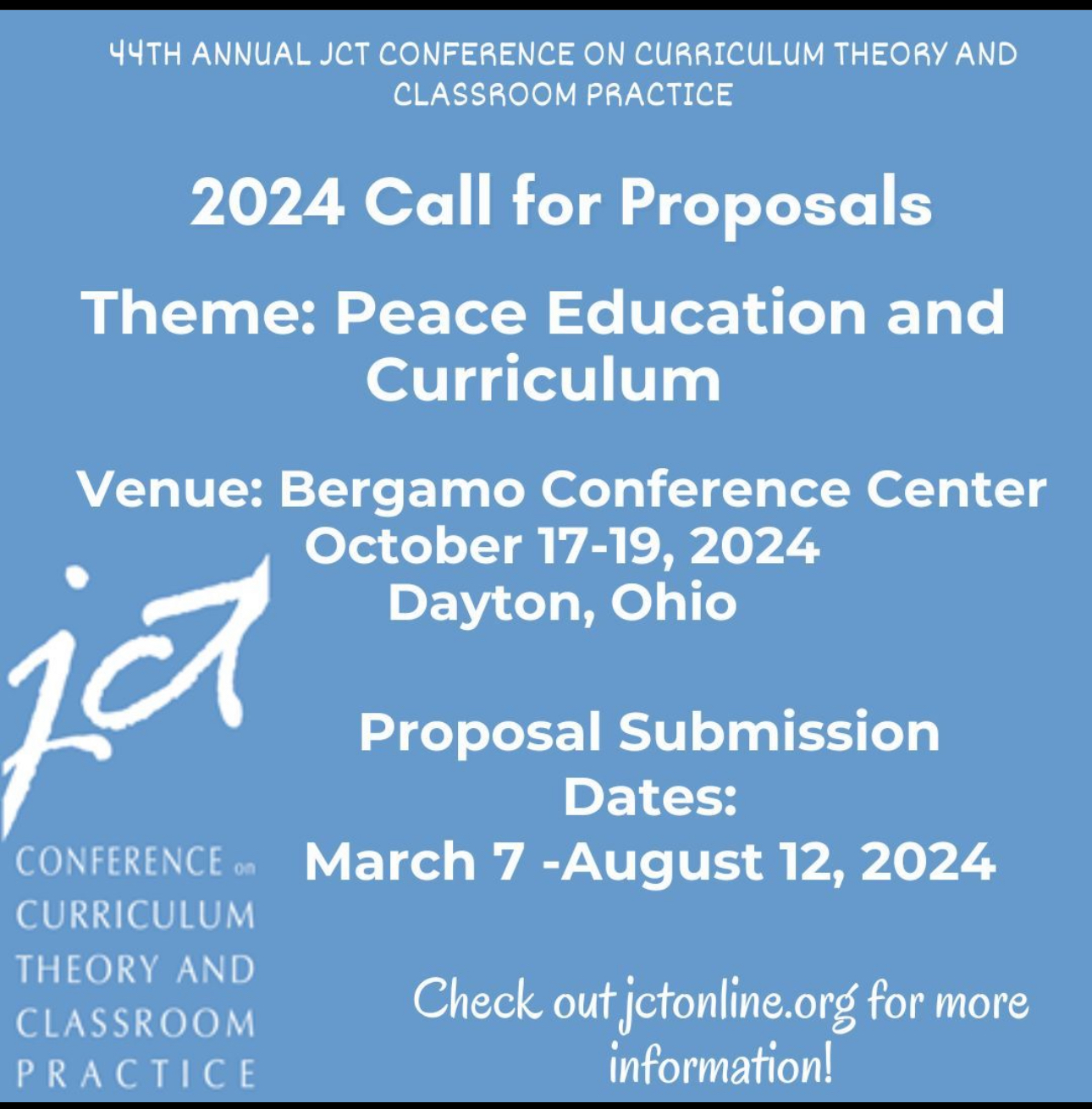
2024 Call for Proposals
We are pleased to invite proposals for the 44th edition of the Journal of Curriculum Theorizing‘s annual Bergamo Conference on Curriculum Theory and Classroom Practice.
Our theme this year is “Peace Education and Curriculum.”. Please click this Link for detailed information on the 2024 call for papers.
For this conference, we essentially ask you to consider :
How do scholar practitioners in the curriculum studies field understand, know, want, create, mistake, and cultivate peace in education, curriculum, pedagogy, politics, religion, economy, health, sexuality, etc. from many perspectives, or not?
In addition to work addressing the conference theme, we invite a wide range of submissions that revolve around, but are not limited to, the following categories:
- Cultural Studies and Curriculum
- International/Transnational Curriculum Discourses
- Engaging Texts
- Higher Education and Curriculum Theorizing
- Curriculum Studies and Philosophical Perspectives
- Curriculum Theory, Classroom Practice, and Disciplinary Perspectives
Here is a link to the conference proposal submission portal. The portal will be open through August 12, 2024.
Click this Link to register for the 44th Annual JCT Conference on Curriculum Theory and Classroom Practice on October 17–19, 2024. Click this Link to reserve a room for the conference at the Bergamo Conference Center in Dayton, Ohio.
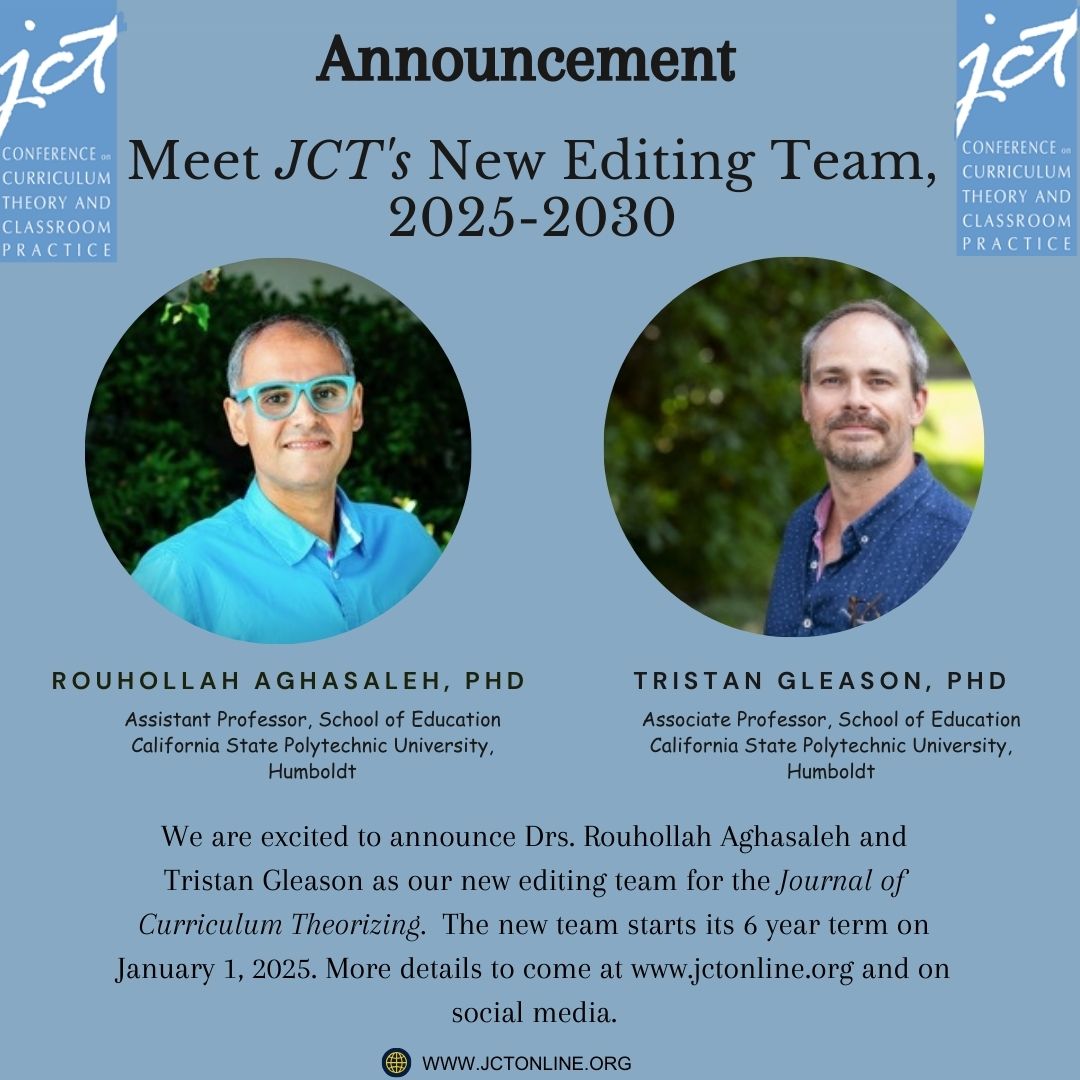
Announcing JCT’s New Editing Team, 2025–2030
After an extensive search process chaired by Isabel Nunez with search team members Denise Baszile and Brian Casemore, we are naming our new editing team and Bergamo conference hosts: Rouhollah Aghasaleh and Tristan Gleason from California State Polytechnic University in Humboldt. Their term begins January 1, 2025, and runs through December 30, 2030. Longtime members of the Curriculum Studies community, Rouhollah and Tristan have a great support team and have secured funding to support the journal and conference for their six-year term. Please join us in congratulating and supporting them on these next steps in their endeavors.
2024 JCT Keynote Speakers
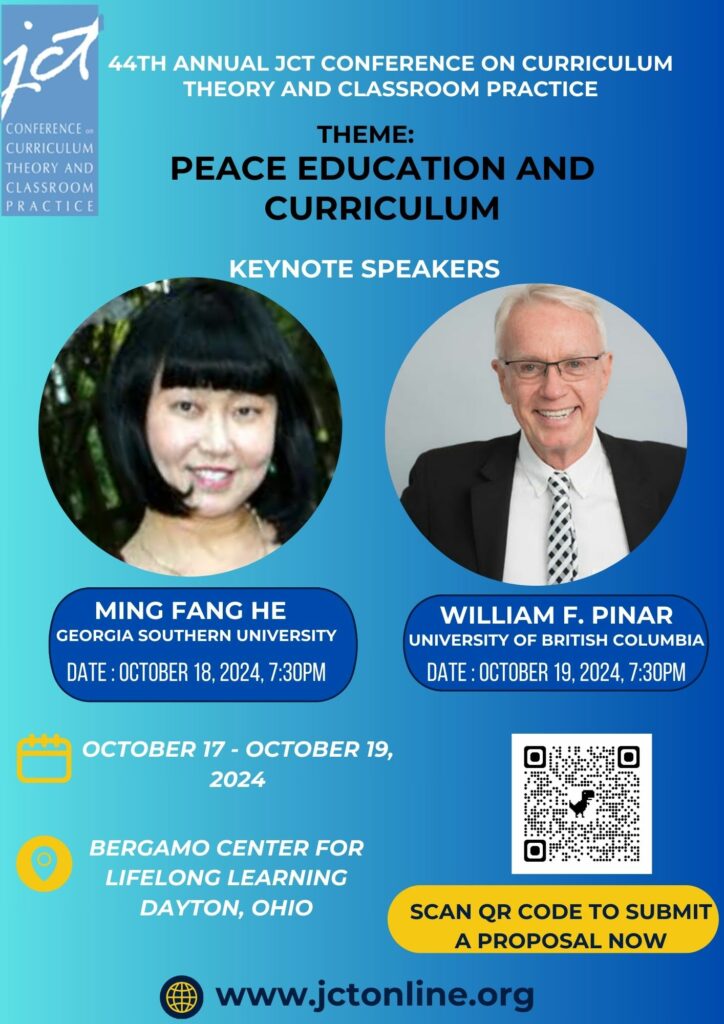
Our keynote speakers:
Ming Fang He, Georgia Southern University
Friday, October 18, 2024, 7:30 pm
“Seeking Peace through Diaspora Curriculum”
AND
William F. Pinar, University of British Columbia
Saturday, October 19, 2024, 7:30 pm
“The Subjective Necessity of Nonviolence”
Keynote History
2023
Brian Casemore: On the Raveling of Deep Aspect: Curriculum as Subjective Place Curriculum
Shauna Knox: Spaces of Possibility: Critical Geography and Curriculum Inquiry
2022
Brian Schultz: Selling School Safety: Surveillance, Profit, and a Not-So Hidden Curriculum
Hongyu Wang: Freedom, Interconnectedness, and Curriculum Attunement: A Cross-Cultural Perspective
2021
Vonzell Agosto—CaRTography as Curriculum: Leaning into the Abyss
Rob Helfenbein—Spaces of Possibility: Critical Geography and Curriculum Inquiry
2019
Rubén A. Gaztambide-Fernández—Toward a Framework for Cultural Production in Education
Theodorea Regina Berry—Joy, Pain, and Hope in Curriculum Theory: A Critical Race Feminist Lyrical Message
Janet Miller —Entangling Relationalities and Differing Differences: Forty Years of Bergamo and JCT Curriculum Theorizings and Practices
2018
Nina Asher—Beyond Dualisms: Interdependence and Possibilities in Education
Nichole Guillory—A Love Letter to Black Women
David Stovall —Because They Have Come for Us, What Are We Prepared to Do? Into the Struggle for Curriculum Studies and Educational Foundations
2017
Lance T. McCready—Educational Trajectories of Black Queer Youth: From Classrooms to Ballrooms and Beyond
Jerry Rosiek—White Supremacy as an Agential Being: Curriculum Studies at the Intersection of Racial Realism and Agential Realism
Erica R. Meiners —Our Problem Child: Provocations on Dismantling the Carceral State
2016
Thomas Popkewitz—Union Organizing within the Neo-liberal State: Power, Solidarity and Imagination The Promise of Practical Knowledge and the Lorelei’s Whisper: Notes from Curriculum & Science Studies about Change that Conserves and Excludes
Petra Munro Hendry—A Rogue Curriculum: Trans-Atlantic, Creole Pedagogies and Historical Imagination
Bettina L. Love —Imagining Mattering: Hip Hop Civics Ed, Intersectionality, & Black Joy
2015
Barbara Madeloni—Union Organizing within the Neo-liberal State: Power, Solidarity and Imagination
Patrick Slattery—Toward Proleptic Experience in Arts-Based Educational Research and Practice
jan jagodzinski —The Arts at the End of the World: The Challenge of Non-representational Thought for Education — Between the Nonhuman and Inhuman
2014
Alan Block—On the Asking of Questions
Janet Miller, Jim Henderson, and Molly Quinn—Expanding Possibilities: Honoring Maxine Greene’s Influences on Curriculum Theorizing
Denise Taliaferro Baszile —In Pursuit of the Revolutionary-Not-Yet: Curriculum Studies as Creative Criticality as Radical Praxis
2013
Greg Dimitriadis—Framing Hip Hop: New Methodologies for New Times
Elizabeth St. Pierre—Post Qualitative Research
M. Francyne Huckaby—Voice, Activism, and Uprising
2011
Handel Wright—Presentist Praxis and the Cultural Studies of Education Formation
Bernadette Baker—Curriculum Studies and the 21st Century: Post-Empirical Research and the Theorization of the Invisible
William Doll—Our Mistake is in our Thinking
2010
Therese Quinn—“Every Tool is a Weapon”: Privatization, Queered Pedagogies and Public Arts Education
Sandy Grande—Education and Disaster Capitalism: Colonization the Re-Mix
Madeleine Grumet—“Gotcha” Curriculum Theory: The Penalties of Abstention
2009
William Watkins—Education and Curriculum in the New Social Order: Turning to Political Economy
Janet Miller—Nostalgia for the Future: Imagining Histories of JCT and Bergamo
Deborah Britzman—Making the Best of a Bad Job: Transference in Education and Psychoanalysis
2008
Patti Lather—Research as Praxis 2.0
Cameron McCarthy—Reading Against the Grain: Interrogating the Concepts of Tradition and Class in the Scholarship of British Cultural Studies
Kevin Kumashiro—The Seduction of Common Sense: How the Right has Framed the Debate on America’s Schools